
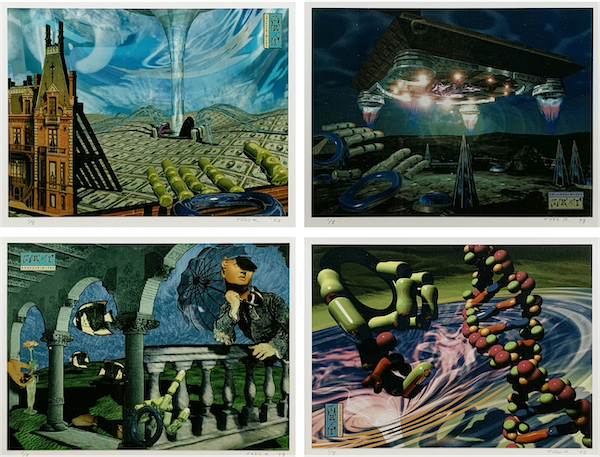
Poverty#1 Exodus#1 Adama#1 Eden#1 year: 1993, size: 21.6 x 29 cm each, computer generate color photo
Vol.4 CROSSING ROADS: Inspired by Todd Rundgren
One of America’s leading musicians and music producers, Todd Rundgren, who has remained active from the 1970s to the present day, returned to Japan following his March 2025 visit. One year later, this year’s performances moved from Billboard Live Tokyo to NHK Hall, with two concerts held including a show at Osaka Zepp.
In addition to his work as a solo artist, he is also widely known as the central figure of the progressive rock band Utopia. Throughout his career, he has produced numerous acclaimed artists including Hall & Oates, XTC, and Meat Loaf. He is also highly regarded as a pioneering figure who early on incorporated video, computer graphics, and interactive media into his artistic expression.
I first encountered Todd’s music when I was in my third year of junior high school. A friend introduced me to the album “TODD”, whose cover featured a portrait of Todd with rainbow-colored hair. From that moment on, his presence became something special to me.
At the time, I was deeply immersed in British progressive rock band, especially YES, and I was astonished to discover that there was an American artist creating music with such experimental spirit and sophistication. I was immediately drawn into the sonic world he created.
That encounter would later become one of the formative influences behind my own gallery activities. Looking back now, I realize that Todd’s refusal to remain confined within conventional genres — his ability to move freely between music, visual imagery, technology, and conceptual thinking — resonated deeply with the philosophy that would later shape my direction as a gallery director: not simply presenting artworks, but creating a space capable of proposing new forms of expression and new ways of thinking.
After moving to the United States in 1978, I attended Todd’s performances whenever he appeared in the San Francisco Bay Area, eventually becoming one of his devoted fans.
Even after opening my gallery in 1984, my enthusiasm for Todd never faded. I often found myself imagining that perhaps one day I might somehow work with him. Then, in July 1993, that opportunity finally arrived.
That year, Todd released “No World Order”, an ambitious interactive project inspired by electronica and rap, allowing listeners themselves to reconstruct and manipulate the music in real time. It was an extraordinarily innovative concept for its era, and is still regarded as one of the earliest interactive musical works developed for the Philips CD-i platform.
Around that time, one of the art dealers with whom I had a close relationship introduced me to Todd’s manager, Eric Gardner.
I immediately contacted Eric and learned that “No World Order” also included accompanying visual imagery. I proposed the idea of presenting these images as limited-edition artworks within a gallery exhibition, alongside live demonstrations of the interactive music system itself.
Todd responded very positively to the idea.
Since CD-R technology was not yet widely available at the time, Todd sent approximately 20 computer graphic images, including multiple color variations, stored on MO (magneto-optical) disks. I printed these works on what was then considered the highest-quality glossy paper available for color reproduction, mounted them through a dry-mount process, and presented them as artworks.
The imagery Todd created clearly reflected the strong influence of the surrealist master Salvador Dalí, whom he greatly admired.
Combined with demonstrations of the interactive music system, the exhibition attracted widespread attention not only from music magazines, but also from art publications and mainstream media.
For me, collaborating with Todd Rundgren within the context of an art gallery was never simply about working with an artist I admired.
Rather, it became a defining experience that reaffirmed my belief that a gallery should function as a place where different disciplines — music, visual art, technology, and conceptual experimentation — can intersect to generate entirely new possibilities of expression.